Moe Miura
The following article is a translation of a Japanese article from the Japan Healthcare Factbook Series posted by the Public Affairs Team at Ubie AI Lab.
When we refer to healthcare facilities, various terms like "hospital" and "clinic" are used, each having distinct characteristics. Let's delve into the differences, the prevalence of these facilities, and how healthcare costs are determined in Japan.
Healthcare Expenditure's Impact on Medical Services Market Size
Understanding the scale of the healthcare industry requires referencing a country's healthcare expenditure.
"Medical expenses" are the costs incurred when receiving healthcare services such as examinations, prescriptions, treatments, and other necessary services at medical institutions or pharmacies due to illness or injury. Thus, medical expenses are synonymous with healthcare service costs, indicating the market size for healthcare providers like hospitals, clinics, and pharmacies. (Reference: Mizuho Bank, Industry Research Department)
Most of Ubie's revenue comes from the "Ubie AI Health Assistant" service, designed for hospitals and clinics. Consequently, we equate healthcare service costs with market size.
Japan's healthcare expenditure has seen steady growth, with an approximate 2.2-fold increase over the past 30 years. As of fiscal year 2018, the latest data shows a record high of nearly 393.5 billion dollars.
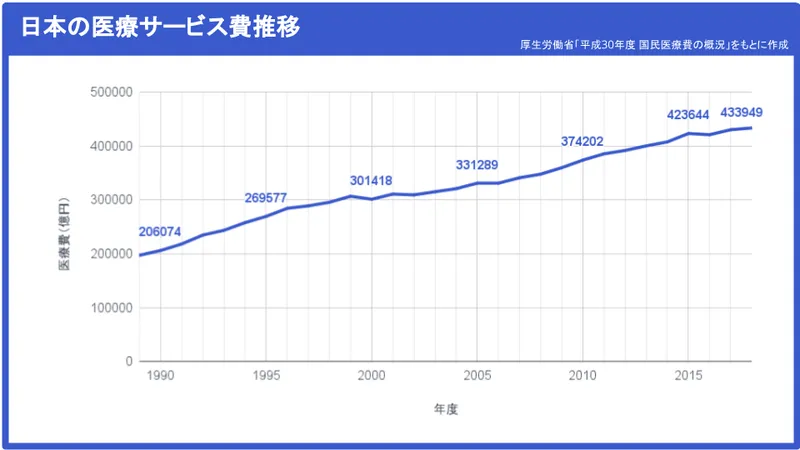
A line graph depicting the increasing trend of Japan's healthcare expenditure over 25 years from 1990 to 2015. The graph slopes upward from the bottom left to the top right, indicating a rise in expenditure over time.
Need for Measures on Japan's Healthcare Costs due to Aging Population
The rise in medical expenses is attributed to the advancement of medical technology and the aging population. Firstly, the development of medical technology has led to increased healthcare costs. Notably, the decrease in medical expenses in 2016 was a reaction to the significant rise in healthcare costs in 2015, primarily due to the introduction of expensive drugs for treating hepatitis C.
Secondly, the aging population in Japan has contributed to increased medical expenses. The country's population has been declining since 2008, with an impending "2025 Problem", where one in three citizens will be 65 or older, and one in five will be 75 or older by 2025.
Elderly individuals are more susceptible to illnesses, leading to frequent medical visits and a higher variety and quantity of prescribed medications. The majority of these medical costs for the elderly are covered by national and municipal finances, leading to concerns about escalating expenditures.
To address this, the “Act on Assurance of Medical Care for the Elderly” (enacted in 1982, revised in 2015), mandates the establishment of principles and plans for the rationalization of medical expenses over six-year periods. As of 2021, we are in the third phase of this plan (*1).
(*1) The three phases (2008-2012, 2013-2017, 2018-2023) are implemented as five-year periods, six-year periods, and six-year periods, respectively.
In recent years, healthcare expenditure has maintained a low growth rate of around 2-3%. This is primarily due to the medical expense rationalization plan. Particularly in 2018, there was a rationalization of dispensing medical expenses for the elderly, despite reaching the highest expenditure level on record, showing a modest increase of 0.8% compared to the previous year.
How will healthcare expenses change in the future?
In the short term, there is a high likelihood that healthcare expenses for the fiscal year 2020 “significantly decreased” due to the impact of the COVID-19 pandemic. However, in the long term, healthcare expenses are projected to continue increasing. Government estimates predict healthcare expenses to be approximately 445 billion dollars in the year 2040, about 1.7 times the amount spent in the fiscal year 2018.
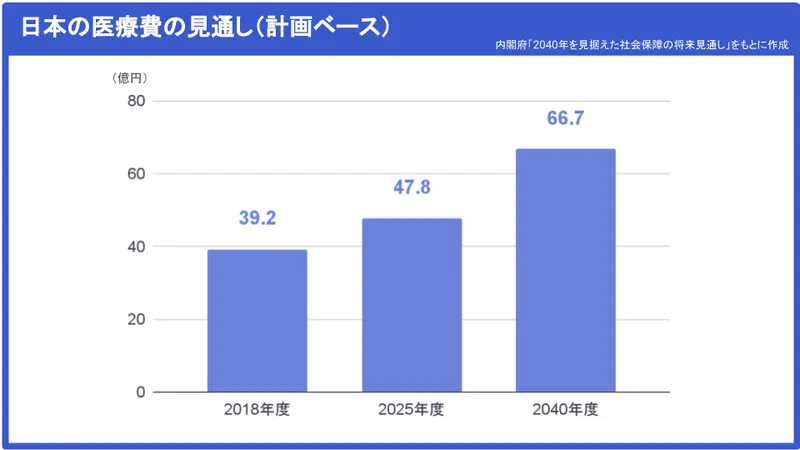
A bar graph predicting the increase in Japan's healthcare costs. The graph shows a gradual rise from 39.2 trillion yen ($261 billion) in 2018 to 47.8 trillion yen ($318 billion) in 2025, and up to 66.7 trillion yen ($445 billion) in 2040, visually representing the future escalation of healthcare expenses.
Worldwide Healthcare Expenditure Expected to Triple by 2023
How about healthcare expenditures in other countries and globally?
Let's start by comparing healthcare expenditures in various countries. The following is the total healthcare expenditure, including both public and private spending, and the ranking by country (*2). Despite Japan's small population and limited land area, it ranks third in total healthcare expenditure.
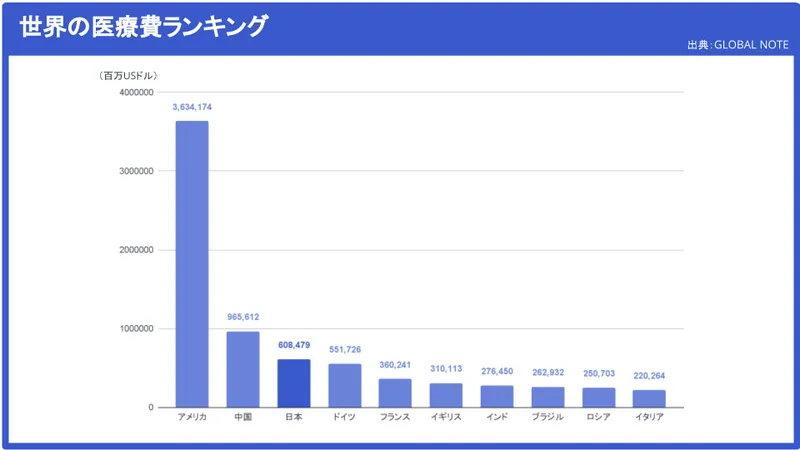
A bar graph showing the ranking of countries by healthcare expenditure. The United States tops the chart with approximately 3.63 million dollars, followed by China, Japan, and Germany. The graph displays the market size of each country with blue bars and numerical values, clearly indicating that the United States has a significantly larger expenditure. Japan is also observed to have the third-largest expenditure.
(*2) Healthcare expenditure covers medical services and drugs, but not capital costs like hospital construction and medical facilities purchase. It includes public spending by government bodies and private insurance obligations. Private expenses involve cost-sharing at medical facilities, private treatments, and contributions to private insurance.
Next is the global ranking of government healthcare spending percentage. This ranks countries by the ratio of public healthcare spending to total government expenditure. Japan ranks second, highlighting the critical importance of healthcare.
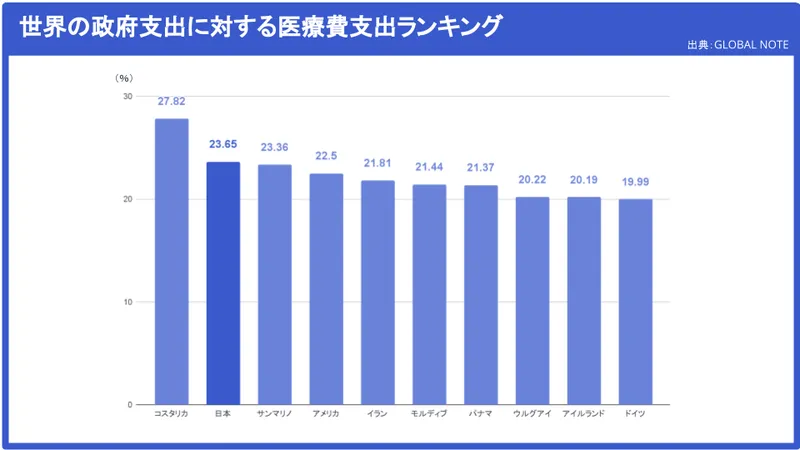
A bar graph displaying the ranking of the percentage of healthcare costs against government expenditure worldwide. Japan is in the second position. The graph is in blue, showing the percentage ratio for each country.
Moreover, global healthcare spending is on a steady increase. As reported by the Global Burden of Disease Health Financing Collaborator Network, a collaboration of professors and researchers from global institutions, global healthcare expenditure is estimated to more than triple, surging from 9.21 trillion dollars in 2014 to over 24.24 trillion dollars by 2040.
As we approach the post-COVID era, there's heightened interest in the evolution of the world's healthcare systems and associated spending.
Conclusion
Healthcare expenses, especially medical service costs, are rising worldwide. Japan, already leading in entering an ultra-aged society, expects its healthcare industry to grow even further. Reforms are in progress to address the "2025 Problem," which is just four years away. Understanding these reforms and the current adoption of various services and technologies can offer glimpses into healthcare's future.
References
北村正樹 [Kitamura, Masaki]. (2015, 9月19日). ハーボニー:著効率100%のC型肝炎治療薬 [Harvoni: A hepatitis C treatment drug with a 100% efficacy rate]. 日経メディカル [Nikkei Medical]. Retrieved from https://medical.nikkeibp.co.jp/leaf/all/series/drug/update/201509/543860.html
みずほフィナンシャルグループ. (2020). ヘルスケア~医療のパラダイムシフトを見据えた日本のヘルスケア産業のとるべき方向性~ [Healthcare: The direction of Japan's healthcare industry in anticipation of a paradigm shift in medical care]. リサーチ&コンサルティングユニット, みずほ銀行 産業調査部. Retrieved from https://www.mizuhobank.co.jp/corporate/bizinfo/industry/sangyou/pdf/1065_09.pdf
厚生労働省 [Ministry of Health, Labour and Welfare]. (2020). 平成30年度 国民医療費の概況 [Overview of National Medical Expenses for Fiscal Year 2018]. Retrieved from https://www.mhlw.go.jp/toukei/saikin/hw/k-iryohi/18/index.html
GLOBAL HEALTH CONSULTING. (2020, December 1). 2018年度国民医療費は43兆3848億円、高齢者の調剤医療費減で伸び率は低い水準に抑えられる―厚労省 [National medical expenses for the fiscal year 2018 are 43.3848 trillion yen, growth rate kept low due to reduction in elderly pharmaceutical medical expenses - Ministry of Health, Labour and Welfare]. Retrieved from https://gemmed.ghc-j.com/?p=37584
厚生労働省 [Ministry of Health, Labour and Welfare]. (2020). 最近の医療費の動向-MEDIAS-(令和2年度) [Recent trends in medical expenses -MEDIAS- (Fiscal Year 2020)]. Retrieved from https://www.mhlw.go.jp/bunya/iryouhoken/database/zenpan/iryoudoukour02.html
内閣官房・内閣府・財務省・厚生労働省 [Cabinet Office, Ministry of Finance, Ministry of Health, Labour and Welfare]. (2018, May 21). 2040年を見据えた社会保障の将来見通し(議論の素材)-概要- [Future prospects of social security looking ahead to 2040 (Materials for discussion) - Summary -]. Retrieved from https://www5.cao.go.jp/keizai-shimon/kaigi/minutes/2018/0521/shiryo_04-1.pdf
GLOBAL NOTE. (2019). 世界の医療費 国別ランキング・推移 [Global medical expenses: Country rankings and trends]. Retrieved from https://www.globalnote.jp/post-10286.html
GLOBAL NOTE. (2018). 政府支出に占める医療費割合 国別ランキング [Government health expenditure as a percentage of total government spending: Country rankings]. Retrieved from https://www.globalnote.jp/post-4457.html
Global Burden of Disease Health Financing Collaborator Network. (2017). Future and potential spending on health 2015–40: development assistance for health, and government, prepaid private, and out-of-pocket health spending in 184 countries. The Lancet, 389(10083), 2005-2030. https://doi.org/10.1016/S0140-6736(17)30873-5
About Ubie's AI Symptom Checker
US Version: https://ubiehealth.com
Japanese Version: https://ubie.app
Ubie's AI Symptom Checker enables users to easily access healthcare information and find appropriate healthcare providers. Available in both Japanese and English, it supports users in identifying symptoms and connecting with the right healthcare providers.
About Ubie
Ubie, Inc., established in 2017, is at the forefront of the digital health revolution. As an innovative startup, Ubie harnesses the power of artificial intelligence to seamlessly navigate individuals towards appropriate healthcare services. Our mission is rooted in the belief that everyone, regardless of location or circumstance, deserves access to comprehensive healthcare. We are committed to transforming this vision into reality by creating a more accessible and user-friendly healthcare experience.
Our global presence is anchored at our headquarters in Tokyo, Japan, situated at the heart of Nihonbashi-Horidomecho, and our U.S. headquarters in the bustling hub of New York City. These strategic locations enable us to cultivate and expand our impact on the healthcare industry worldwide.
U.S. Headquarters:
1460 Broadway, New York, NY 10036
Japan Headquarters:
6th Floor, Nihonbashi-Horidomecho 2-chome Bldg.
2-4-3, Horidomecho, Nihonbashi, Chuo-ku, Tokyo, 103-0012
Inception:
May 2017 - Japan Operations
October 2022 - U.S. Operations
Leadership:
Co-founders, Kota Kubo and Dr. Yoshinori Abe, spearhead our ambitious journey with a shared dedication to enhancing healthcare accessibility through innovative solutions.
Discover more about our vision and endeavors at: https://ubiehealth.com/company
Disclaimer: Please be advised that Ubie's AI Symptom Checker is intended solely for informational purposes and does not constitute a substitute for professional medical diagnosis, advice, or a treatment plan. Users should always seek the advice of qualified health professionals regarding any medical conditions or treatment decisions.
Author

Moe Miura
Public Affairs Lead, Ubie AI Lab

Moe is the leader of the Public Affairs Team at Ubie AI Lab. After a stint at the Ministry of Internal Affairs and Communications, where she was involved in overseeing Japan's telecommunications industry and other related areas, she has been focusing on Public Affairs at Ubie since 2021.