Moe Miura
The following article is a translation of a Japanese article from the Japan Healthcare Factbook Series posted by the Public Affairs Team at Ubie AI Lab.
Hello, this is the Ubie Public Affairs Team. We would like to explore the present and future of the healthcare industry through the Japan Healthcare Factbook.
We would like to introduce "Reforming the Working Style of Physicians." In response to this challenge, Ubie released the "Ubie AI Health Assistant" in Japan in August 2018.
With the rapid spread of the COVID-19 pandemic, there has been a significant acceleration in "workstyle reform" over the past year. New and normative working methods, such as remote work, are becoming established in general businesses. Similarly, the healthcare industry is also gearing up for a comprehensive initiative towards reforming the working style of physicians.
Limits on Overtime Work for Physicians Starting in 2024
The Labor Standards Act amendment enacted in April 2019 set a maximum overtime limit for ordinary workers at 720 hours per year, excluding holiday work. Penalties were also introduced for employers who violate this rule.
However, a grace period was given to physicians for applying these limits, which will last until April 2024.
In March 2019, the Ministry of Health, Labour, and Welfare organized a study group to promote the reform of physicians' working styles. At this meeting, a policy was formed to regulate physicians' overtime work. The plan involves creating three tiers—A, B, and C—each with its own maximum overtime limit.
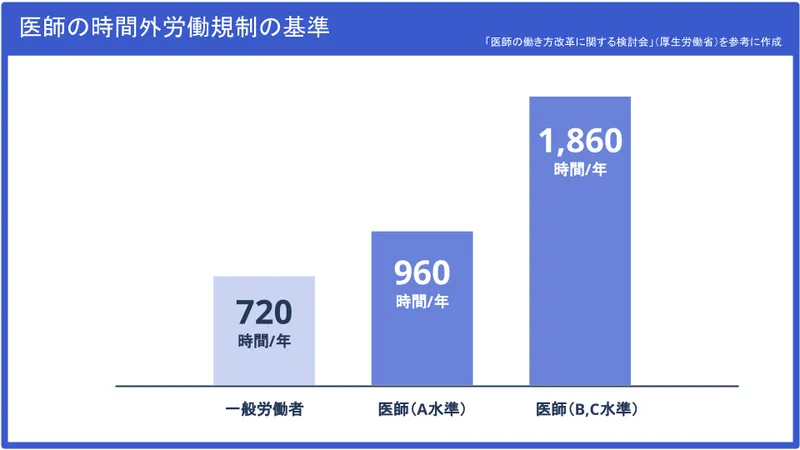
A bar graph comparing the overtime hours of general workers and doctors in Japan. Doctors' working hours vary by level, with Level A at 960 hours per year, and Levels B and C at 1,860 hours per year, significantly exceeding the 720 hours per year of general workers.
During the study group, we aimed to establish a general rule of "up to 960 hours of overtime work per year" across all healthcare providers. This limit, often referred to as the "A level," is known as the "death by overwork line," a criterion for recognizing work-related injuries in cases of brain and heart diseases.
In healthcare, due to its unique nature characterized by uncertainty, public nature, high level of expertise, and technological innovation, it's been decided that, for now, longer working hours than ordinary workers are necessary. The goal is to eventually match the standards of regular workers.
However, crucial healthcare providers like Level 3 Emergency Hospitals and Level 2 Emergency Hospitals, which accept over 1,000 emergency ambulances annually on a 24-hour basis, face challenges in reducing working hours. Therefore, a decision has been made to limit physicians' overtime to a maximum of 1,860 hours per year, known as the "B level," until 2035.
In cases requiring intensive experience accumulation over a short period, such as resident doctors, overtime is also limited to a maximum of 1,860 hours per year, referred to as the "C level."
Currently, efforts are underway to identify healthcare providers under the B level and promote support measures to help as many providers as possible maintain the A level. The plan is to abolish the B level by 2035 and phase out the C level eventually.
The Current Harsh Working Conditions of Physicians
Indeed, just how rigid are these working hour limits? According to the “Physician Working Conditions Survey” conducted by the Ministry of Health, Labour and Welfare in September 2019, 37.8% of physicians exceeded Level A (up to 960 hours annually, including holidays). Moreover, the top 10% of physicians worked over 1,824 hours of overtime annually. Nearly 40% of physicians would be penalized at this rate.
Why are physicians driven to such extensive overtime? The primary reason is the mandatory availability for urgent medical care, outlined in the Medical Practitioners Act and Dentists Act. It stipulates that physicians cannot refuse to provide medical services unless there's a valid reason. This obligation ensures free access, allowing individuals in Japan to seek medical care from any healthcare institution or physician without limitations. This unrestricted access is unique compared to some countries where individuals must first visit a registered healthcare institution.
While this system offers reassurance for patients, it places a significant burden on healthcare professionals (HCPs). Factors such as attending to patients needing medical attention outside regular hours, performing lengthy surgeries that cannot fit within standard working hours, and handling a high volume of outpatient cases contribute to the intense workload for medical practitioners. It's fair to say that the commitment of HCPs underpins this system.
Furthermore, the extensive administrative tasks, like maintaining patient records, increase overtime work. As per a U.S. study, every additional hour spent on outpatient consultations results in two hours of administrative work, including electronic health record input and desk work (see “References and Sources”). In Japan, a survey by the Ministry of Health, Labour and Welfare indicates that over half of physicians identify "medical record creation (administrative work)" as the primary reason for overtime work.
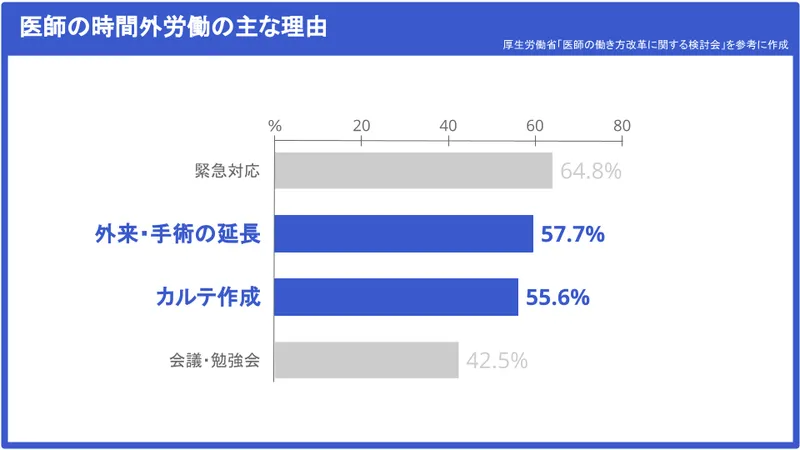
A bar graph showing the main reasons for doctors' overtime work in Japan. From the top, emergency response at 64.8%, outpatient and surgical extension at 57.7%, charting at 55.6%, and meetings/study sessions at 42.5%.
Towards Improving the Working Environment for Physicians
In light of these considerations, the study group strongly recommends healthcare providers to implement "urgent measures to reduce physicians' working hours." It emphasizes the importance of meticulous labor management and working hour reduction. The specific recommendations comprise six points:
Proper management of physicians' working hours
Self-audit of agreements, like the "36 Agreement"
Use of existing occupational health mechanisms
Promotion of task shifting (specializing physicians in tasks that "only doctors can perform" and delegating tasks that "can be performed by individuals without a medical license," such as nurses, to other professions)
Support for female physicians
Initiatives to reduce physicians' working hours
Among these, the introduction of the "Ubie AI Health Assistant" exemplifies the "Promotion of Task Shifting.” It was included as a subsidy target in the "Task Shifting and Improvement of the Medical Working Environment Promotion Project" managed by the Ministry of Health, Labour and Welfare in 2019 and 2020.
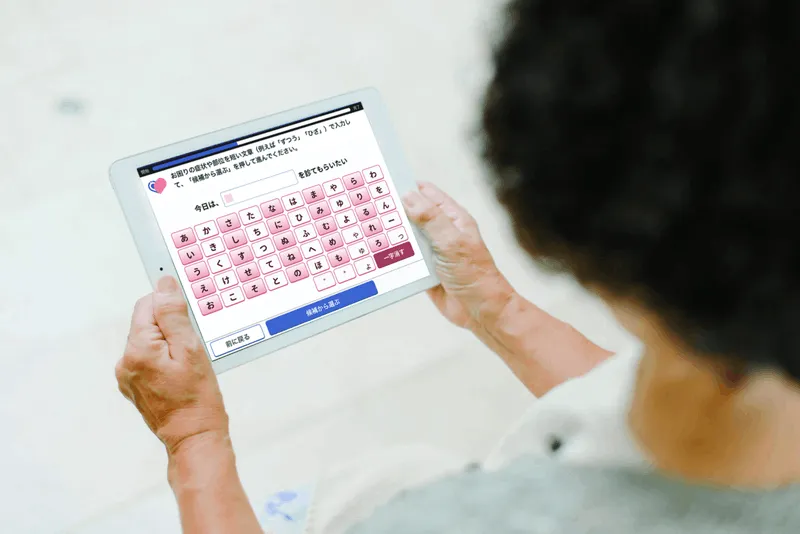
As of December 2023, “Ubie AI Health Assistant” has been implemented in over 1,500 healthcare providers in Japan, with notable cases demonstrating operational efficiency and task shifting. Here are some examples.
Case Study 1: Takeda General Hospital in Kyoto Prefecture
Takeda General Hospital in Kyoto Prefecture improved consultation time efficiency by approximately 30%.
Comparing the average consultation time before and after the introduction of AI-assisted diagnosis, the time reduced from 12 minutes and 18 seconds to 8 minutes and 41 seconds. This decrease of 3 minutes and 37 seconds (29.4% of consultation time) per patient resulted in a total daily reduction of about 40 minutes for the 10-15 new patients targeted for AI-assisted diagnosis. Over five days, this amounted to nearly 200 minutes saved. According to Dr. Keiichiro Nakamae from the Department of General Medicine and Endocrinology, the workload of outpatient nurses has also decreased.
Case Study 2: Okayama Kyokuto Hospital in Okayama Prefecture
Okayama Kyokuto Hospital in Okayama Prefecture has reduced patient stay time by more than 20 minutes through operational efficiency.
Before and after the introduction of AI-assisted diagnosis, new patients requiring interviews experienced a decrease in waiting time from reception to consultation by 3.5 minutes (from 53.4 minutes to 49.9 minutes). Total stay time from reception to billing also decreased by 21 minutes (from 189 minutes to 168 minutes). Vice Director Hideyuki Doi noted improvements in various aspects, including better reception handling, shorter consultation times for physicians, reduced nurse workload, and administrative task assistance for support staff.
Conclusion
As the three-year limit on physician overtime work approaches, there is a mounting demand for better working conditions in the medical field, paralleling efforts to tackle the ongoing challenges of the COVID-19 pandemic.
In various sectors, the application of AI has advanced to boost operational efficiency. Companies are increasingly adopting tools such as Sansan and SmartHR, prominent Japanese startups specializing in business card management and labor management, respectively. Salesforce is also popular for sales management. Similarly, in the healthcare industry, there is a growing expectation that AI usage will play a vital role in increasing the productivity of healthcare professionals and enhancing work conditions.
References
Ministry of Health, Labour and Welfare. (2019). 医師の働き方改革に関する検討会報告書 [Report of the Study Committee on Promoting Workstyle Reforms for Physicians]. Retrieved from https://www.mhlw.go.jp/content/10800000/000496522.pdf
Study Committee on Promoting Workstyle Reforms for Physicians. (2020, December 22). 医師の働き方改革の推進に関する検討会 中間とりまとめ [Interim summary of the Study Committee on Promoting Workstyle Reforms for Physicians]. Ministry of Health, Labour and Welfare. https://www.mhlw.go.jp/content/10800000/000708161.pdf
Japan Medical Association. (n.d.). 日本の医療保険制度の優れた特徴 [The excellent features of Japan's health insurance system]. Retrieved from https://www.med.or.jp/people/info/kaifo/feature/
Sinsky, C., Colligan, L., Li, L., Prgomet, M., Reynolds, S., Goeders, L., Westbrook, J., Tutty, M., & Blike, G. (2016). Allocation of Physician Time in Ambulatory Practice: A Time and Motion Study in 4 Specialties. Annals of Internal Medicine, 165(11), 753-760. https://doi.org/10.7326/M16-0961
The Study Committee on Promoting Workstyle Reforms for Physicians. (2018, February). 医師の労働時間短縮に向けた緊急的な取組 [Urgent measures toward reducing working hours for physicians]. Ministry of Health, Labour, and Welfare in Japan. https://www.mhlw.go.jp/file/05-Shingikai-10801000-Iseikyoku-Soumuka/0000195363.pdf
About Ubie's AI Symptom Checker
US Version: https://ubiehealth.com
Japanese Version: https://ubie.app
Ubie's AI Symptom Checker enables users to easily access healthcare information and find appropriate healthcare providers. Available in both Japanese and English, it supports users in identifying symptoms and connecting with the right healthcare providers.
About Ubie
Ubie, Inc., established in 2017, is at the forefront of the digital health revolution. As an innovative startup, Ubie harnesses the power of artificial intelligence to seamlessly navigate individuals towards appropriate healthcare services. Our mission is rooted in the belief that everyone, regardless of location or circumstance, deserves access to comprehensive healthcare. We are committed to transforming this vision into reality by creating a more accessible and user-friendly healthcare experience.
Our global presence is anchored at our headquarters in Tokyo, Japan, situated at the heart of Nihonbashi-Horidomecho, and our U.S. headquarters in the bustling hub of New York City. These strategic locations enable us to cultivate and expand our impact on the healthcare industry worldwide.
U.S. Headquarters:
1460 Broadway, New York, NY 10036
Japan Headquarters:
6th Floor, Nihonbashi-Horidomecho 2-chome Bldg.
2-4-3, Horidomecho, Nihonbashi, Chuo-ku, Tokyo, 103-0012
Inception:
May 2017 - Japan Operations
October 2022 - U.S. Operations
Leadership:
Co-founders, Kota Kubo and Dr. Yoshinori Abe, spearhead our ambitious journey with a shared dedication to enhancing healthcare accessibility through innovative solutions.
Discover more about our vision and endeavors at: https://ubiehealth.com/company
Disclaimer: Please be advised that Ubie's AI Symptom Checker is intended solely for informational purposes and does not constitute a substitute for professional medical diagnosis, advice, or a treatment plan. Users should always seek the advice of qualified health professionals regarding any medical conditions or treatment decisions.
Author

Moe Miura
Public Affairs Lead, Ubie AI Lab

Moe is the leader of the Public Affairs Team at Ubie AI Lab. After a stint at the Ministry of Internal Affairs and Communications, where she was involved in overseeing Japan's telecommunications industry and other related areas, she has been focusing on Public Affairs at Ubie since 2021.