Moe Miura
The following article is a translation of a Japanese article from the Japan Healthcare Factbook Series posted by the Public Affairs Team at Ubie AI Lab.
When we refer to healthcare facilities, various terms like "hospital" and "clinic" are used, each having distinct characteristics. Let's delve into the differences, the prevalence of these facilities, and how healthcare costs are determined in Japan.
Distinct roles of "Hospitals" and "Clinics"
When feeling unwell, Japanese people often say they're "going to the hospital." However, in most cases, the first place they visit isn't strictly a "hospital." What does this mean?
In Japan, medical institutions are defined in the first article of the Medical Care Act as "hospitals" and "clinics."
A "hospital" is a medical institution with 20 or more beds (the number of beds where patients can be admitted). Hospitals with 20 to 99 beds are "small hospitals," those with 100 to 499 beds are "medium hospitals," and those with 500 or more beds are "large hospitals."
Hospitals meeting specific requirements can use special designations with the Minister of Health, Labour, and Welfare's approval. For example, national and university hospitals providing advanced medical technology, development, and training are "specified function hospitals." Hospitals offering 24-hour emergency medical care and supporting community healthcare are "regional medical support hospitals." University hospitals and cancer centers conducting international-level clinical research are "core clinical research hospitals."
Meanwhile, medical institutions with no beds or fewer than 19 beds are categorized as "clinics." This includes dental clinics. The term "local doctor" or "town doctor" often refers to the HPCs in these clinics. Due to their smaller scale, clinics face less stringent regulations regarding structural facilities than hospitals.
Also, "clinics" are sometimes called "medical clinics" or just "doctor's offices." While some may be concerned about differences between the terms, it's essentially a matter of phrasing.
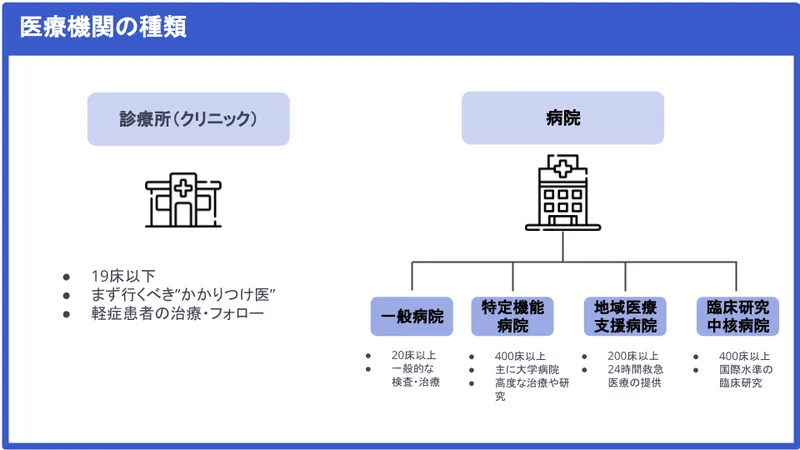
A diagram of medical facilities. "Clinics" on the left provide primary care and emergency follow-ups, with less than 19 beds. In the center, "General Hospitals" have over 20 beds for common treatments, while "Specified Function Hospitals" offer specialized treatments with over 400 beds. On the right, "Regional Medical Support Hospitals" provide 24/7 support for terminally ill patients with over 200 beds, and "Clinical Research Core Hospitals" offer international standard treatments with over 400 beds.
Hospitals and clinics serve different functions due to their unique definitions.
Clinics primarily focus on outpatient care, acting as the initial point of contact for healthcare services. They are often referred to as the "primary care physician". On the other hand, hospitals specialize in inpatient care, providing advanced medical treatments and emergency care.
In Japan, the "Free Access" system allows patients to choose their healthcare facility freely. However, this system has a drawback: patients with minor illnesses often visit large hospitals, causing a preference for major hospitals. Despite efforts from the Ministry of Health, Labour and Welfare, and medical associations to promote awareness of these functional differences, a definitive solution has not been found.
Given this context, proposals have been made to systematize healthcare facility functions. Initiatives have been introduced to differentiate functions by assigning unique names to each role. This has led to the establishment of the Medical Care Act.
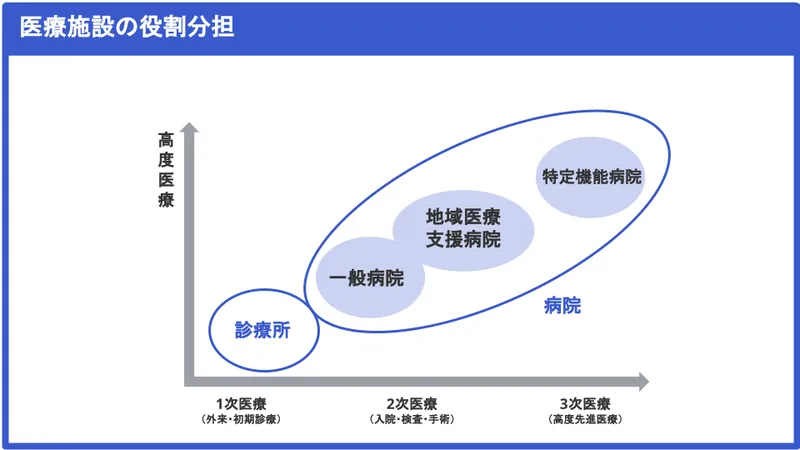
A diagram showing role distribution in medical facilities, from primary clinics to specialized hospitals. It represents a systematic framework of collaboration, increasing in sophistication and specialization upward and rightward.
Hospitals and clinics have different staffing standards due to their varying functions.
For hospitals, the staff includes nurses, assistant nurses, and nursing aides. Other staff such as pharmacists, dietitians (for hospitals with 100 beds or more), and depending on the department, professionals like radiological technologists, occupational therapists, and physiotherapists are also needed. Certain types of hospitals, like regional medical support hospitals, specified function hospitals, and core clinical research hospitals, may require even more healthcare staff.
In contrast, clinics' staffing standards, even with recuperation beds, only necessitate nurses, assistant nurses, and nursing aides. It's important to note that clinics without beds can legally operate with just a physician.
Even though roles differ, medical expenses remain the same
Next, we'll delve into the differences in medical expenses that notably affect us as patients.
Regardless of whether you go to a hospital or a clinic (often referred to as a "medical office"), the individual's responsibility for medical expenses remains generally the same if the examination or test conducted is identical. This is irrespective of the size of the medical institution. The reason is the existence of a universal fee termed "medical fees". These fees are administratively revised every two years, with the upcoming revision set for the fiscal year 2022.
"Medical fees" denote the compensation that insurance medical institutions and insurance pharmacies receive from insurers as payment for insurance medical services. This is commonly referred to as "insured medical treatment." Essentially, prices for medical procedures are pre-established, and a maximum self-payment limit is determined (*1). This system ensures we receive appropriate medical care without substantial financial burdens. These medical fees encompass costs such as staff salaries for healthcare professionals, procurement of pharmaceuticals and medical materials, and facility maintenance and management.
Nonetheless, when visiting a hospital without a referral from a clinic, special charges might be levied. This is referred to as the "Fee for Treatment of Patient’s Choice."
*1 For treatments like cutting-edge cancer therapies, there might be "free treatments" that public medical insurance (health insurance, national health insurance, late-stage elderly medical care system) doesn't cover.
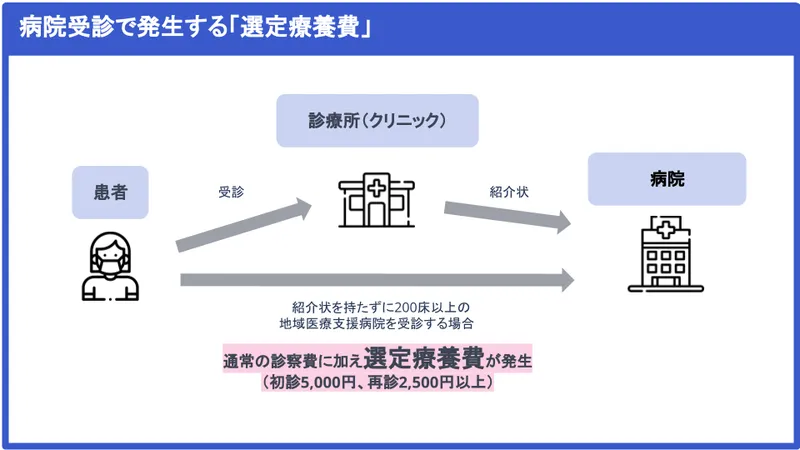
This flowchart explains the "Fee for Treatment of Patient’s Choice" in hospitals. It shows a patient visiting a clinic, then a hospital. If the clinic refers you to the hospital, you avoid the fee. But, if you go directly to a hospital with more than 200 beds, you'll be charged 5,000 yen (approximately $33) for the first visit and 2,500 yen (approximately $17) for following visits.
The division of roles between clinics and hospitals was established under the Medical Insurance System Reform Act, enacted in May 2015. The act delineates clinics for treating mild or routine illnesses and hospitals for emergencies or severe conditions.
According to the 2020 revision of medical fees, at regional medical support hospitals with 200 beds or more, it became mandatory to collect a separate "Fee for Treatment of Patient’s Choice" if there is no referral letter for the initial consultation (*2). The fees are set at "5,000 yen (about $30) for the first visit and 2,500 yen (about $16) or above for subsequent visits". Each hospital can determine these amounts. Therefore, it's beneficial to first seek care at a clinic. If you plan to visit a hospital without a referral letter, it's recommended to check the hospital's website or other sources in advance for the presence and cost of the “Fee for Treatment of Patient’s Choice”.
*2 This excludes recipients of the national public expense medical care system, victims of traffic accidents, occupational injuries, etc.
Fewer Doctors, More Hospitals? Japan's Healthcare Paradox
Let's explore Japan's healthcare system by examining the number of medical facilities nationwide.
As of January 2021, the Ministry of Health, Labour and Welfare reported approximately 179,331 medical institutions in Japan. This includes nursing homes, pharmacies, and other facilities. Among these, around 8,300 are hospitals, and the majority, about 103,000, are clinics. For comparison, Japan has approximately 56,000 convenience stores. This signifies there are significantly more clinics than convenience stores in the country.
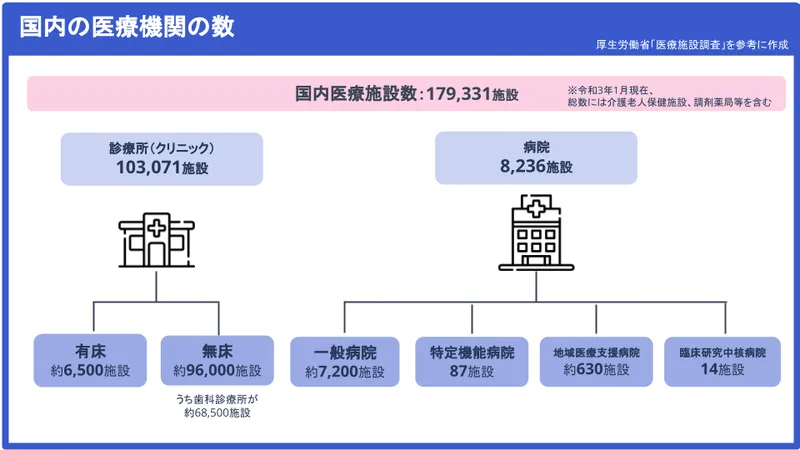
A chart depicts Japan's medical facilities. Totaling 179,331, with 103,071 clinics and 8,236 hospitals. Hospitals include 7,200 general, 87 specific function, 630 regional support, and 14 research ones. Clinics are 6,500 bedded, 96,000 non-bedded with 68,500 being dental clinics.
Japan significantly stands out when compared to other countries. According to the Organization for Economic Co-operation and Development (OECD), Japan has the highest number of hospitals worldwide. Even the United States, which is in second place, has approximately 6,000 hospitals. (*As of 2018)
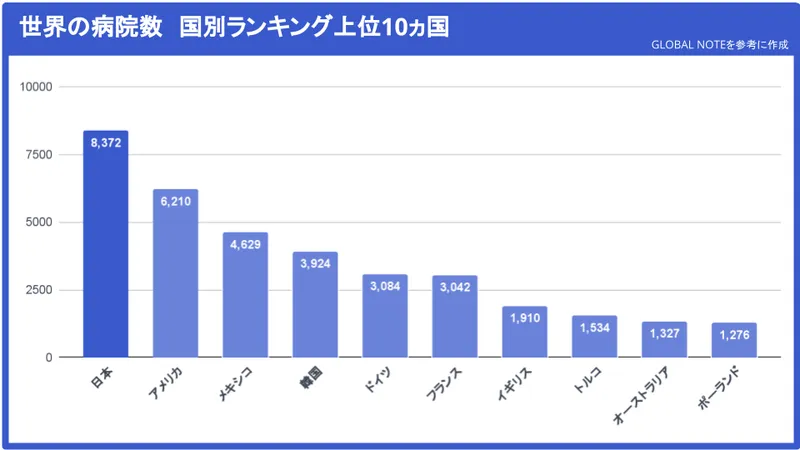
A bar graph showing the rankings of countries based on the number of hospitals worldwide. Japan is at the top with around 8,372 hospitals, followed by the United States, Mexico, South Korea, Germany, France, the United Kingdom, Turkey, Australia, and Poland, in that order.
Despite the high number of hospitals, the number of physicians per capita in Japan is relatively low. According to the OECD, Austria has the highest number of physicians per 1,000 people at 5.24. In contrast, Japan has only 2.49 physicians per 1,000 people as of 2020, which is significantly below the OECD average of 3.5. This ranks Japan in the 32nd position, highlighting a substantial disparity. (*As of 2020)
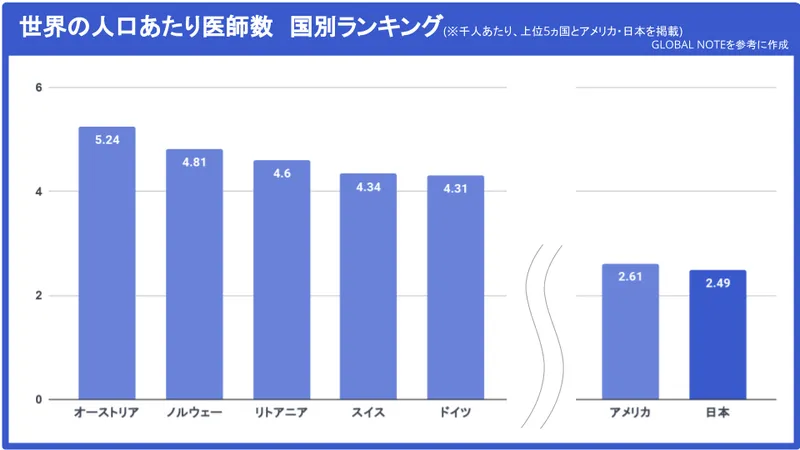
A graph comparing the number of doctors per 1,000 people internationally. Each country is represented by a blue bar. Austria has the highest number at 5.24, followed by Norway at 4.81 and Lithuania at 4.60. The United States and Japan have fewer doctors, with 2.61 and 2.49 respectively, compared to other countries.
In Japan, a country that entered an advanced aging society before others, it has become crucial to address the shortage of medical personnel and the resulting long work hours. As a result, there is growing demand to improve productivity in the healthcare field.
Conclusion
In this article, we've provided fundamental information on the definitions of healthcare institutions, which lays the groundwork for understanding the healthcare industry's structure.
A thorough understanding of the roles of hospitals and clinics is crucial for grasping their needs and challenges. By understanding these differences, patients can make informed decisions about which healthcare institution to visit.
References
Ministry of Health, Labour and Welfare. 医療施設動態調査 用語の解説 [Explanation of terms in the survey of medical facility dynamics]. Retrieved from https://www.mhlw.go.jp/toukei/saikin/hw/iryosd/08/dl/02.pdf
Ministry of Health, Labour and Welfare. (2007). 医療法に基づく人員配置標準について [Standards for staffing based on the Medical Care Act]. Retrieved from https://www.mhlw.go.jp/shingi/2007/03/dl/s0323-9b.pdf
Japan Medical Association. Understanding medical fees. Retrieved from https://www.med.or.jp/people/what/sh/ [Originally in Japanese: 『なるほど診療報酬!』]
Ministry of Health, Labour and Welfare. (2021). 医療施設動態調査(令和3年1月末概数)[Medical institutions survey (Preliminary figures for January 2021)]. Retrieved from https://www.mhlw.go.jp/toukei/saikin/hw/iryosd/m21/dl/is2101_01.pdf
Global Note. 世界の病院数 国別ランキング・推移 [Number of hospitals in the world: Country rankings and trends]. Retrieved from https://www.globalnote.jp/post-10233.html
Global Note. (2018 and 2020). 医師数(人口あたり)[Number of physicians per population]. Retrieved from https://www.globalnote.jp/p-data-g/?dno=6930&post_no=10213
Japan Medical Association Comprehensive Policy Research Institute. (2019). 医療関連データの国際比較-OECD Health Statistics 2019- [International comparison of health-related data - OECD Health Statistics 2019]. Retrieved from https://www.jmari.med.or.jp/download/RE077.pdf
Ministry of Health, Labour and Welfare. (2020). 個別改定項目について(355ページ、外来医療の機能分化の推進)[Regarding individual revision items (Page 355, Promotion of functional differentiation of outpatient medical care)]. In Overview of the Fiscal Year 2020 Revision of Medical Fees and Charges. Retrieved from https://www.mhlw.go.jp/content/12404000/000601838.pdf
About Ubie's AI Symptom Checker
US Version: https://ubiehealth.com
Japanese Version: https://ubie.app
Ubie's AI Symptom Checker enables users to easily access healthcare information and find appropriate healthcare providers. Available in both Japanese and English, it supports users in identifying symptoms and connecting with the right healthcare providers.
About Ubie
Ubie, Inc., established in 2017, is at the forefront of the digital health revolution. As an innovative startup, Ubie harnesses the power of artificial intelligence to seamlessly navigate individuals towards appropriate healthcare services. Our mission is rooted in the belief that everyone, regardless of location or circumstance, deserves access to comprehensive healthcare. We are committed to transforming this vision into reality by creating a more accessible and user-friendly healthcare experience.
Our global presence is anchored at our headquarters in Tokyo, Japan, situated at the heart of Nihonbashi-Horidomecho, and our U.S. headquarters in the bustling hub of New York City. These strategic locations enable us to cultivate and expand our impact on the healthcare industry worldwide.
U.S. Headquarters:
1460 Broadway, New York, NY 10036
Japan Headquarters:
6th Floor, Nihonbashi-Horidomecho 2-chome Bldg.
2-4-3, Horidomecho, Nihonbashi, Chuo-ku, Tokyo, 103-0012
Inception:
May 2017 - Japan Operations
October 2022 - U.S. Operations
Leadership:
Co-founders, Kota Kubo and Dr. Yoshinori Abe, spearhead our ambitious journey with a shared dedication to enhancing healthcare accessibility through innovative solutions.
Discover more about our vision and endeavors at: https://ubiehealth.com/company
Disclaimer: Please be advised that Ubie's AI Symptom Checker is intended solely for informational purposes and does not constitute a substitute for professional medical diagnosis, advice, or a treatment plan. Users should always seek the advice of qualified health professionals regarding any medical conditions or treatment decisions.
Author
Moe Miura
Public Affairs Lead, Ubie AI Lab

Moe is the leader of the Public Affairs Team at Ubie AI Lab. After a stint at the Ministry of Internal Affairs and Communications, where she was involved in overseeing Japan's telecommunications industry and other related areas, she has been focusing on Public Affairs at Ubie since 2021.