Alexander Kerman

Over recent years, healthcare in the United States has witnessed a growing commitment to health equity. Health equity aims to level the healthcare playing field, offering equitable access to high-quality healthcare. Currently these gaps are massive, with a roughly 15 year difference in life expectancy between the richest and poorest Americans. Increasingly patients, pharmaceutical companies, healthcare providers, advocacy groups, and other stakeholders look to bridge care gaps and ensure everyone can access comprehensive treatment. Yet while these parties share a belief in health equity, differing incentives and resource constraints limit action. This is where pharma can lead the way: by using technology to identify undiagnosed and undertreated patients, pharma can help close care gaps, while growing their markets.
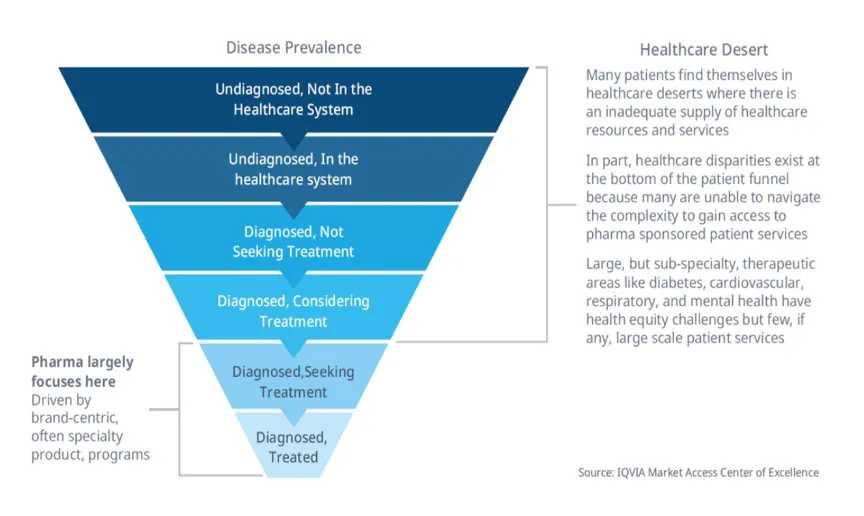
Many of the top global pharmaceutical companies have made commitments to health equity, but they tend to undervalue commercial applications with only 50% recognizing health equity as a potential business driver.. Most attention goes towards representation in clinical trials, a vital goal but one that does not directly drive revenue. On the commercial side, pharmaceutical companies focus their patient marketing efforts on branded advertising to diagnosed patients who either are seeking or are already on treatment (Figure 1, bottom). However, this assumes patients can navigate the healthcare system and leaves more vulnerable individuals lost in the complexity of the healthcare system. Many of these patients never receive diagnoses or prescriptions, representing a massive – and infrequently recognized – opportunity cost for pharma. Even previously diagnosed patients often do not continue treatment, with less than 50% of patients on treatment a year after starting, so reducing friction to access care should be a top priority for pharma. Without a clear understanding of the financial and strategic opportunities associated with addressing health equity gaps, there is a decreased emphasis on improving equity within pharma commercial teams.
Figure 1: Disease Prevalence Pyramid
Pharma focuses its commercial efforts on the bottom of the funnel, competing amongst themselves for patients who have already been diagnosed. Guiding undiagnosed patients towards diagnoses and care is challenging, but AI-powered solutions like Ubie can help discover more patients and navigate them towards effective care.
Source: IQVIA Market Access Center of Excellence
Pharma has tried to tackle these disparities through disease awareness campaigns and patient support programs, but AI powered technology offers a more efficient path forward. Unbranded awareness campaigns aim to increase diagnoses by empowering individuals to seek care if they recognize hallmark symptoms. While these campaigns can reach large audiences, the relevancy is necessarily low by definition: patients cannot possibly know what they do not know! So the ROI of these campaigns tends to be low due to weak targeting (akin to other mass market patient marketing). These campaigns have the dual purpose of helping patients seek care while also growing the treatable market. Support programs play a similarly vital role, although in this case the target audience consists of previously diagnosed patients facing challenges to pay for their treatment. By offering patients various types of financial support, pharma firms boost adherence in these vulnerable populations, thus growing their market as well. However most patient support programs tend to have low utilization because it is challenging to target messaging to the right patients at the right time – just as with awareness campaigns. This targeting challenge is where Ubie can help.
Unlocking Opportunities Across the Patient Funnel
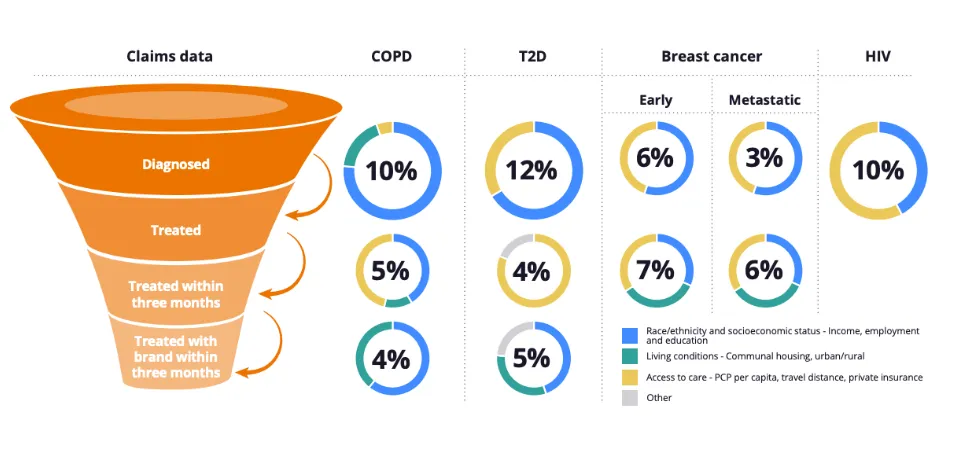
While business leaders everywhere have recognized AI’s potential to transform every industry, relatively few pharma companies are making it a central part of their business. A recent report by Bain found that while 59% of healthcare organizations announced a health equity strategy, fewer than half had integrated health equity into their commercialization strategy. As a result, the gap remains large, leaving striking opportunities to make an impact, as shown in a separate study by ZS Associates (Figure 2, below). By mitigating issues along the patient journey, ZS estimated that pharma firms could increase the number of patients on therapy by 45% to 75%. (Interestingly, the most impactful levers cluster around access to care – which coincidentally is where Ubie thrives.) There are promising signs that pharma is realizing this and that health equity is beginning to gain steam; Bain also found that over half (53%) believe health equity strategies can increase revenue and pharma firms ranked health equity in their top 3 priorities. Put another way, it is the perfect time for pharma innovators to make an impact and develop a reputation for leadership, now that organizations are beginning to understand the value of this work.
Figure 2: Improving the Patient Journey
Increasing treatment rates is the largest driver for 3 out of 4 therapeutic areas, but this is limited by access to care. Access challenges (yellow) represent the most addressable gaps for pharma to solve through telehealth, broader screening, and partnerships with patient advocacy organizations.
Source: https://www.zs.com/content/dam/pdfs/the-business-imperative-for-health-equity.pdf
Ubie: Bridging the Divide
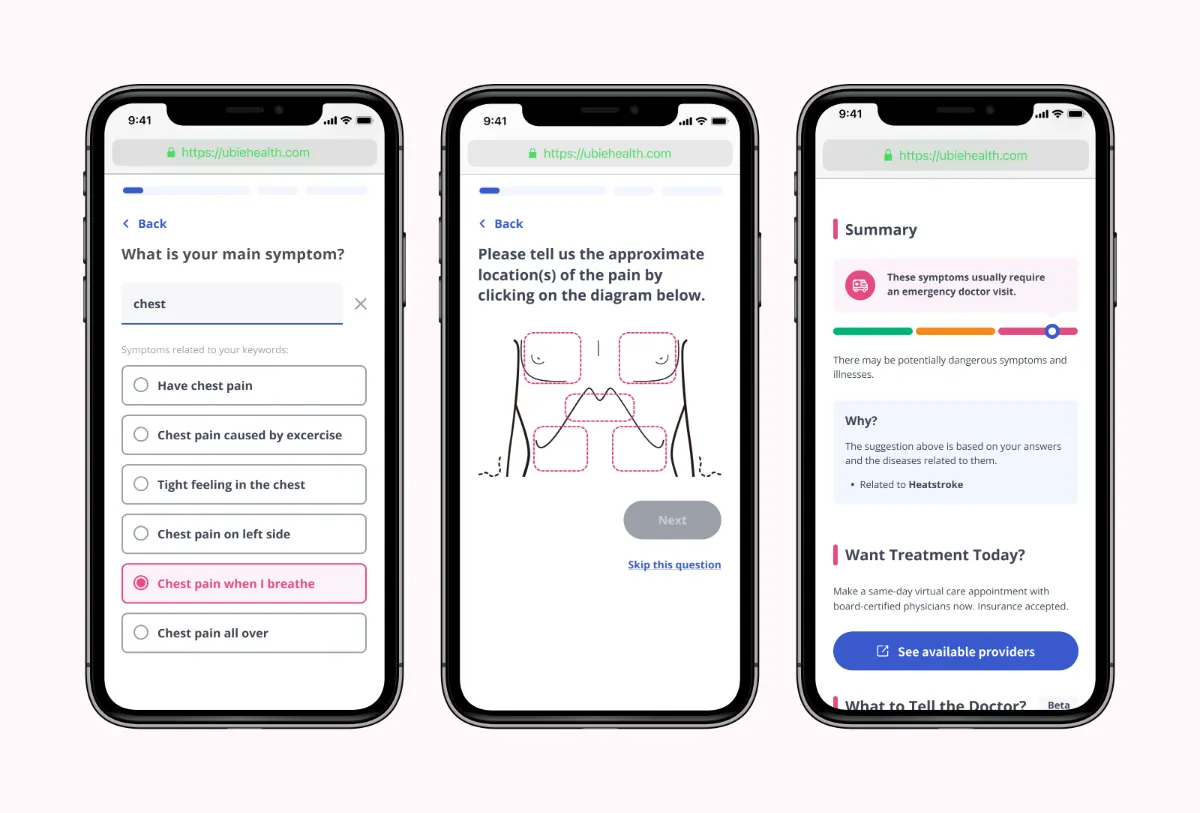
As pharmaceutical companies begin focusing on health equity, one of the simplest and fastest ways to make an impact is by partnering with organizations like Ubie. As an AI care navigation company, Ubie’s goal is to guide everyone to appropriate care with the power of technology. We help patients access high quality medical information with minimal friction and then guide them to care via our free web-based AI Symptom Checker. After 2-3 minutes of AI-selected questions, patients see 8 potential causes with detailed information on each, as well as help scheduling in-person or telehealth appointments (Figure 3, below). Users love using our tools and we are constantly working to make them even better.
For our pharma partners, we essentially offer a targeting solution for any of their branded or unbranded campaign goals. Because our AI Symptom Checker filters down to suspected diseases for each patient, we can present content that is hyper-relevant to their specific needs at that moment. These are very high-intent audiences, as users come to us when they are motivated to look into their symptoms and then Ubie activates them further with educational content. Crucially, Ubie then can follow-up with registered patients to remind them to seek care, assess outcomes (e.g., HCP visits, confirmed diagnoses, new prescriptions, etc.), and even share branded content. This zero-party data helps pharma firms develop better relationships with patients and understand the challenges that they face.
This is more than a theory: Each month, more than 7 million users trust Ubie to provide information on over 1,100 diseases across all therapeutic areas. In Japan, Ubie already has worked with over 30 of the largest biopharma and more than 1,500 clinics use Ubie’s tools. We launched in the US last year – perfect timing considering the healthcare industry stands poised at the precipice of transformative change. Trailblazers like Ubie have the potential to propel us towards a brighter and more equitable future. Health equity should stand as a strategic priority for us all – but especially pharma companies, given the alignment of their ethical and financial goals.
Figure 3: Ubie Symptom Checker
Ubie’s free AI Symptom Checker only takes 2-3 minutes to provide personalized guidance on patients’ symptoms. At the end of the check, users get recommendations on the most likely causes of their symptoms, including information on treatment options. From there, they can connect directly to telehealth via one of Ubie’s partners.
Source: https://ubiehealth.com/
Author

Alexander Kerman
Head of Growth, Pharma

Xander Kerman's healthcare career is defined by his commitment to improving the industry's efficiency and fairness, blending private sector expertise with a strong biomedical background. He first encountered real-world data (RWD) and value-based care at Dana-Farber Cancer Center, themes he continued working on while in medical school at the University of Chicago. Eventually he shifted his focus to defining healthcare's future as a business leader rather than a clinician, pivoting to Boston Consulting Group (BCG), where he tackled various biopharma, public health, and medical device projects. Following this, he took on successive leadership roles at pioneering health tech startups nference and Syntegra, before joining Ubie to lead its US commercial expansion.